
Recovery · Peptide Therapy
BPC-157 is a 15-amino-acid fragment of a protective protein your stomach already makes. People turn to it when a tendon, joint, gut lining or nerve has stalled partway through healing, because it restores the four conditions every tissue needs to repair itself: blood supply, the right cells arriving, matrix laid in the right direction, and inflammation that knows when to stop. At Osteopathic Health of Orlando, Shawn St. Marie, D.O. prescribes it as a repair adjunct inside a complete plan, never as a stand-alone fix.
Physician-prescribed · Injection, IV, subcutaneous or oral strip · Free discovery call for new patients
Quick Answer
The lining of your stomach produces a protective protein called Body Protection Compound. It is the reason gastric tissue survives an environment that would destroy most other tissue. BPC-157 is a 15-amino-acid fragment of that protein: the active sequence, isolated and synthesized.
It behaves less like a growth factor and more like a coordinator. Rather than forcing one tissue to grow, it restores the conditions tissue needs to repair itself: blood supply, cell recruitment, matrix organization, and inflammation that resolves on schedule. That is why one molecule is studied in tissues as different as tendon, intestinal lining, lung and brain. It works on the shared machinery of repair, not on each tissue separately.
For most people the practical question is simpler: a recovery has plateaued, and they want to know whether it is worth a conversation. If your healing has stalled on one of those four conditions, it is.
The Mechanism
How one repair signal rebuilds tissue, restores the gut and quiets inflammation.
Repair fails without perfusion. BPC-157 increases expression of VEGFR2 in injured tissue, the receptor that reads the body’s main vessel-growth signal, and drives it through the Akt–eNOS cascade. Endothelial cells migrate, form tubes and build capillary networks into the injured bed. In vessel-occlusion models it also recruits collateral circulation, rerouting flow around a blocked segment instead of waiting for it to clear.
Nitric oxide governs vessel tone, platelet behavior and endothelial integrity. BPC-157 corrects NO signaling in both directions: it counteracts the vasoconstriction and endothelial damage seen when NO production is blocked, and buffers the damage from NO excess. The result is a stabilized system rather than a stimulated one, which is why blood pressure and platelet function stay regulated instead of being driven.
Through FAK–paxillin signaling, BPC-157 makes fibroblasts spread, adhere and migrate into the wound. It switches on EGR-1 and its corepressor NAB2, the early trigger for the local cytokine and growth-factor program, and increases growth hormone receptor density on tendon fibroblasts, so your own growth hormone works harder at the injury site without raising hormone levels across the body.
Healing is not simply filling a defect; it is laying fiber in the right direction. In tendon, ligament, muscle and bone models BPC-157 increases collagen deposition and improves fiber alignment, with measurable gains in tensile strength and load tolerance rather than bulkier, weaker scar.
BPC-157 lowers TNF-α and IL-6, the two cytokines that hold an injury or a gut flare in the inflammatory phase, and reduces markers of oxidative injury such as malondialdehyde and myeloperoxidase. Less free-radical damage, fewer neutrophils pulled into healthy tissue, and an earlier handover from inflammation to rebuilding.
Much of the peptide’s reach travels the vagus nerve; interrupt that connection in animal models and part of the benefit disappears. BPC-157 also steadies dopamine and serotonin signaling and protects the barriers at both ends of the axis, intestinal tight junctions and the blood–brain barrier. Gut and brain are treated as one circuit because physiologically they are one.
One principle: restore the conditions under which the body repairs itself. Restore perfusion. Recruit the repair cells. Organize the matrix. Quiet the cytokines.
Patient education. The mechanisms described on this page are drawn principally from preclinical and early translational research. Discuss your individual situation with Dr. St. Marie.
The Peptide
Gly · Glu · Pro · Pro · Pro · Gly · Lys · Pro · Ala · Asp · Asp · Ala · Gly · Leu · Val
Where It Fits
BPC-157 is not a stand-alone therapy. At Osteopathic Health of Orlando it is used as a repair adjunct, layered onto manual treatment, regenerative injections and infusions, rehabilitation, and gut, immune and metabolic optimization, so the tissue has both the signal and the conditions to rebuild. These are the situations where Dr. St. Marie most often considers it.
Tendinopathy and tendon tears, ligament sprains and instability, muscle strain and crush injury, joint capsule and labral irritation, and bone stress injury. It is also used to support recovery after orthopedic or general surgery.
Reflux and esophageal irritation, gastritis and ulcer disease, inflammatory bowel conditions, recurrent diverticulitis or colitis, barrier dysfunction, and healing after bowel surgery. The gut is where BPC-157 originates, and where its effects are best characterized.
Lowering inflammatory load in the liver and lungs, which can matter for people managing COPD or asthma flares when corticosteroids are not tolerated or not wanted.
Nerve injury and neuropathic pain, recovery after head injury or stroke, infectious encephalitis, multiple sclerosis, and the brain fog that follows them.
Tissue by Tissue
The same four conditions, applied to the tissues people actually come in about.
In models of pulmonary hypertension, thoracic trauma and lung injury arising from abdominal pathology, BPC-157 lowers pulmonary pressures and reduces edema, congestion and inflammatory infiltrate. Its vascular and cytokine effects at work, not a lung-specific action.
Because the mechanism operates at the level of vessels and cytokines, the effect is not organ-restricted. Models show protection of liver, kidney, heart and vasculature under inflammatory or toxic stress.
Preservation of the blood–brain barrier, reduced edema and lesion volume after traumatic injury, maintained function after neurotoxic insult, and steadier dopamine and serotonin signaling. The axis runs both ways: a calmer gut sends the brain less inflammatory traffic.
Findings above are drawn from preclinical and early translational research summarized in the practice’s BPC-157 patient information.
Why Route Matters
Where the peptide goes determines what it can reach. Dr. St. Marie chooses the route, and often combines them, based on the tissue involved.
Usual choice for musculoskeletal work
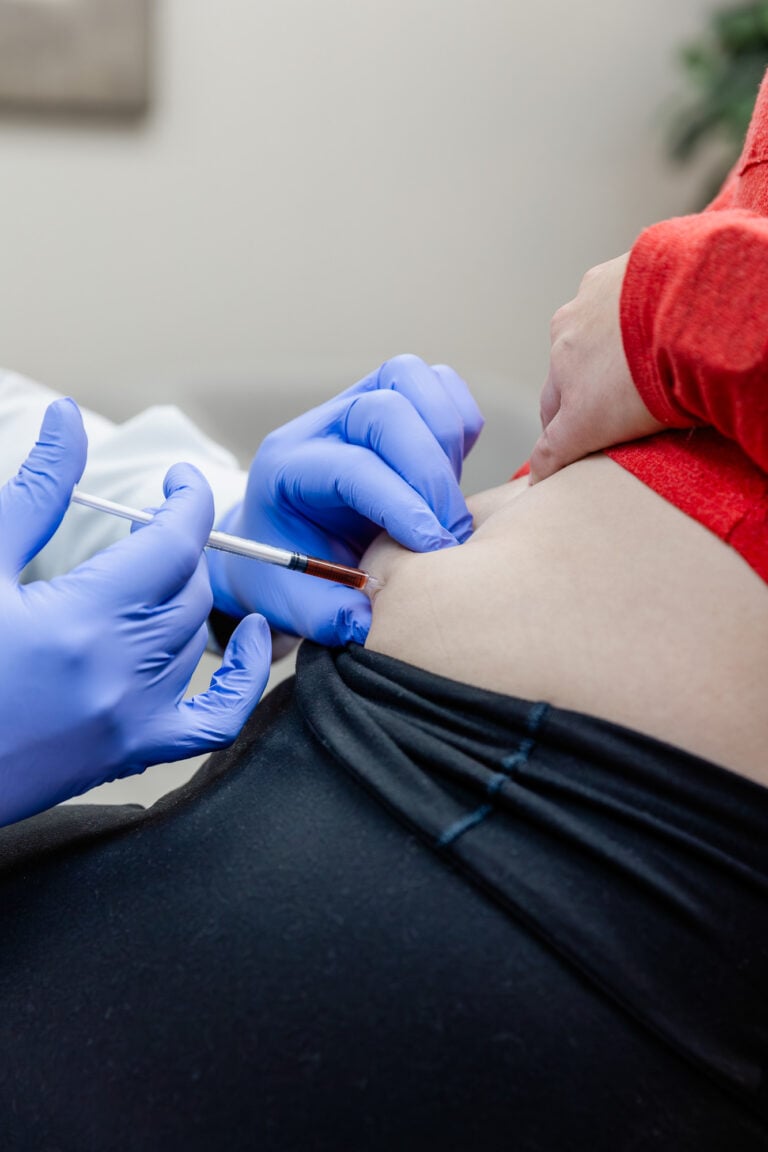
Placing the peptide directly into the injured tissue puts the signal where new capillaries and fibroblasts are actually needed.
Highest doses, whole-body reach
The best opportunity to deliver higher doses and work systemically. The preferred route for reaching the brain and central nervous system, as well as organs and the colon.
Maintenance and continuation
An excellent option for ongoing treatment and maintenance after IV infusion or guided injections, or when injections and infusions are not possible or convenient.
Convenient maintenance
A patented formula with 93% bioavailability, so BPC-157 can be continued at home without needles. Convenient for maintenance phases.
Route, dose and duration are set by Dr. St. Marie based on the tissue involved, the state of your gut, your other therapies and your goals, then reassessed against function, not just symptoms.
The pattern patients describeSwelling settles sooner, the stalled phase shortens, and tissue that normally plateaus at partial strength keeps gaining. Improvement that follows function rather than outrunning it.
Is It Right for You?
Every tissue heals on the same four conditions: blood supply, the right cells arriving, matrix laid in the right direction, and inflammation that knows when to stop. If your recovery has stalled on one of them, it is worth a conversation.
Dr. St. Marie is a licensed physician with his own pharmacy relationships, and BPC-157 here is prescribed only after a one-on-one assessment. Start with a free discovery call, or book your assessment directly.
Getting Started
A short call about your goals and whether BPC-157 is worth exploring. There is no cost and no commitment.
Dr. St. Marie reviews your injury, imaging, health history, gut history and current medications in a one-on-one visit, and orders testing if it would add useful insight.
If BPC-157 is a reasonable fit, he prescribes it and sets the route, dose and schedule with you, alongside whatever else your recovery needs. Follow-ups measure function and adjust the plan.
Because the assessment covers your history and medications, you get a plain answer on whether BPC-157 makes sense for you. For how booking works, see how to schedule a visit.
BPC-157 Questions
BPC-157 (Body Protection Compound 157) is a 15-amino-acid fragment of a protective protein made in the lining of your stomach, isolated and synthesized. It acts as a coordinator of repair, restoring blood supply, cell recruitment, matrix organization and the resolution of inflammation, which is why it is studied in tendon, gut, lung and nerve tissue alike.
Through six pathways: new blood supply, nitric oxide balance, growth-factor amplification, collagen and matrix organization, cytokine and oxidative-stress control, and the gut–brain axis. The common thread is one principle: restore the conditions under which the body repairs itself.
Four ways, chosen by Dr. St. Marie for the tissue involved: injection directly into the injured tissue (the usual choice for musculoskeletal work), IV infusion for higher doses and whole-body reach, subcutaneous injection for continuation and maintenance, and oral dissolving strips with 93% bioavailability for convenient maintenance at home. Many plans combine routes over time.
The pattern patients describe is that swelling settles sooner, the stalled phase of recovery shortens, and tissue that normally plateaus at partial strength keeps gaining. Progress is measured against what you can do, not only how you feel, and reviewed at each follow-up.
No. It is a repair adjunct, layered onto manual treatment, regenerative injections or infusions, rehabilitation, and gut, immune and metabolic optimization, so the tissue has both the signal and the conditions to rebuild.
No. BPC-157 is not an FDA-approved drug. Here it is an elective therapy, prescribed by a licensed physician after a one-on-one assessment, and it is not represented as preventing or curing any disease. Dr. St. Marie walks you through what is known and what is not before you decide.
Book online through our Jane scheduling page, request a free discovery call, or call the office at (407) 506-4776. Every plan starts with a conversation and an assessment.
BPC-157 is offered as an elective therapy and is not FDA-approved. Care here isn’t intended to diagnose, treat, cure or prevent disease, and whether it fits you is decided with Dr. St. Marie after an assessment. See all peptides.
Our Integrative Services
 Neck & Back Pain
 Headaches
 Migraines
 Pelvic Pain and Incontinence
 Shoulder Pain
 Hip, Knee, and Foot pain
 Pregnancy Pain
 Post Stroke pain & weakness
 Post Operative Pain
 Complex Medical Cases
 Autoimmune diseases
 Liver Health & Detoxification
 Weight loss
 Hormone imbalance
 Joint & tendon injuries
 Arthritis & degenerative wear
 Newborns & Infant issues
 Facial paralysis
 Chronic Respiratory Issues

Inside our Baldwin Park office